Can an AI assistant help me with an appraisal?
Douglas Kuss, Certified Residential Appraiser
Yes — as a reader and a drafter, never as the appraiser. Connected to DataPro360, an assistant can stage comparable sales into your import queue, propose text to a review shelf in your Text Library, and read the parts of an open file you switch on; it cannot write into a report, run an analysis, or change your data, and it decides nothing.
What it can actually do today
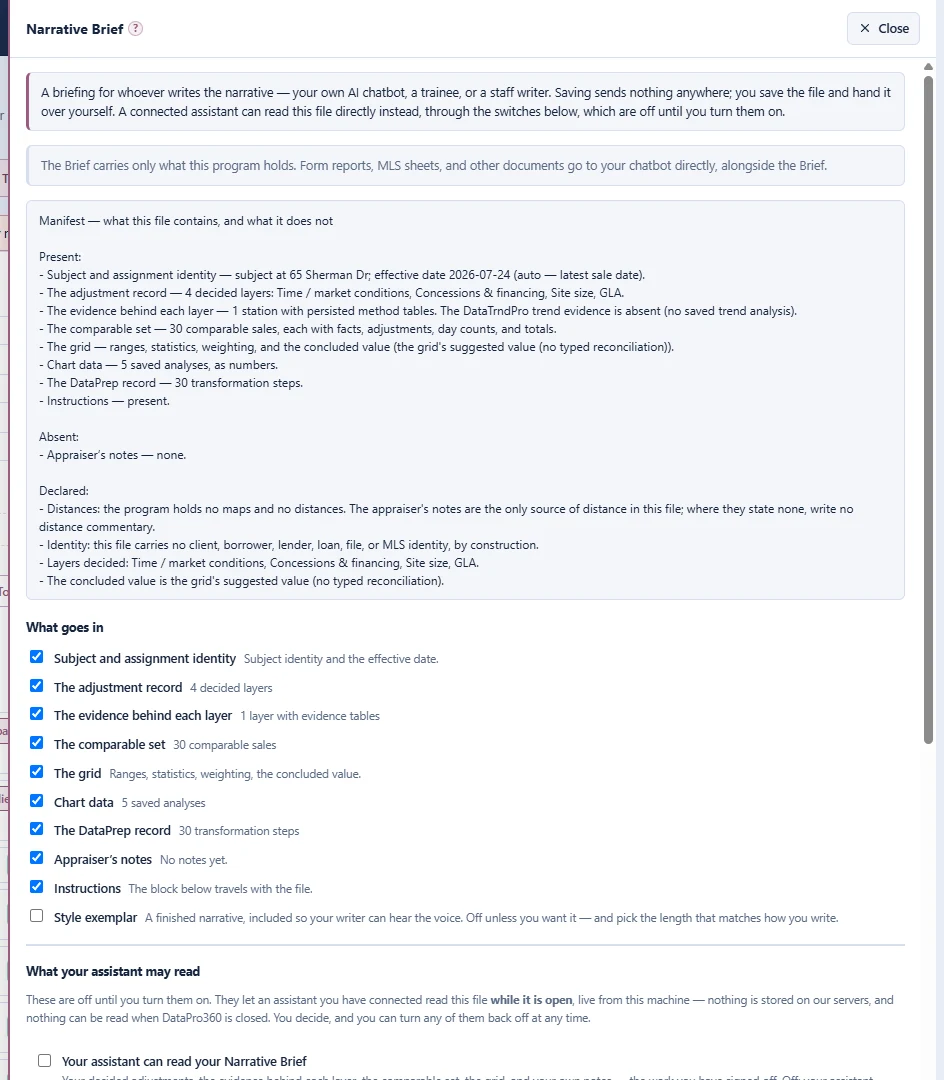
Read the open file — the parts you permit. Each read is its own switch: the comparable rows as they were loaded and as you prepared them, the record of every preparation step, each station's method-by-method evidence — every method's rate, its fit, how many sales it used, whether it votes, the band, and the rate you decided — the Comp Grid's own totals, the comp detail pages, a list of what photos the report carries, the Subject Property page, the report outline, the ratio study, the saved trend analyses, and the Narrative Brief: your decided adjustments, the evidence behind each layer, the comparable set, the grid, and your own notes — the work you have signed off, not raw data.
Draft narrative from the real numbers. The Brief is the right source for writing narrative: it carries decisions, not ingredients, and every figure in it is a finished number — so an assistant writing from it restates what the file says instead of computing from retyped fragments, and derives no adjustment of its own.
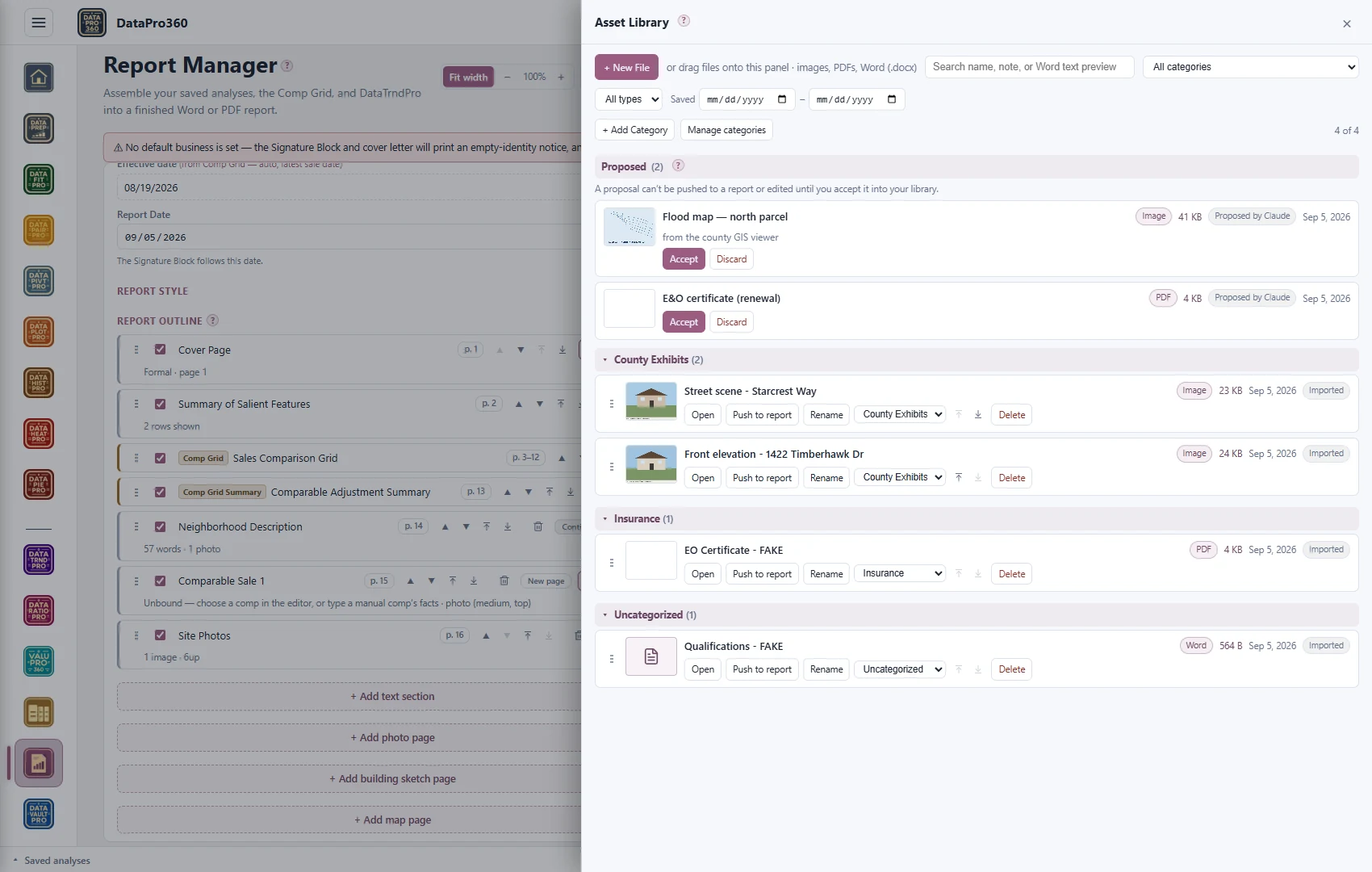
Stage and propose — never place. It can stage comparable sales rows for the signed-in appraiser, where they wait in the import queue until you load them yourself. It can propose text to the review shelf in your Text Library, and propose a file to the review shelf in your Asset Library. A proposal cannot be pushed to a report or edited until you accept it into your library — accept or discard, and either way the decision is yours.
What it cannot do
It cannot decide an adjustment. The program's own orientation states the rule the connector inherits: the methods are computed and shown; which ones to trust, which sales to exclude, and the final number are the appraiser's, and they are what gets signed. It cannot write into the analysis — not an adjustment, not a grid cell, not a report section; there is no path in the program by which it writes anything except the staging queue and the review shelves, all of which wait on you. And it cannot see anything not switched on: every read is off until you turn it on, an oversized answer is refused with its size named rather than quietly shortened, and photographs are reported as a list only — the image bytes are never returned, whether the switch is on or off.
Who controls what it sees
You do, switch by switch. There are fourteen switches and thirteen reads — the fourteenth grants no data of its own, because the MLS switch is a fence, not a read. They live in the Narrative Brief panel under "What your assistant may read," and three levels set them together: Nothing, where your assistant reads nothing from this file — every file starts here, and stays here until you choose otherwise; Your decided work, the conclusions you have reached and the words you have written, not the sales data underneath them; and Everything, which adds the evidence underneath — with MLS listing numbers the one thing it does not include. The MLS number is withheld from every read, recognised by its field role rather than its column name, and no general setting opens that fence — only its own switch, under Advanced.
The connection itself is yours the same way: made under your own account with your own provider, and revocable — turn any switch back off at any time, or remove the connector in your assistant and the whole arrangement ends.
What it is good for in review
The reads carry the evidence, not just the answer. A station read returns every method's rate, fit, sample and vote alongside the decided rate — reported separately from the calculated one — and a saved narrative comes back with a drift flag saying whether the station has moved since it was saved. That shape makes an assistant useful in the one place appraisers rarely get help: point it at a finished file and ask what the support actually shows — whether the bands hold the decided rates, which decisions sit on thin counts, where the narrative and the tables disagree. Both Claude and ChatGPT reached this conclusion on their own when first connected: the interesting use is not writing the file, it is reading one.
Which assistants
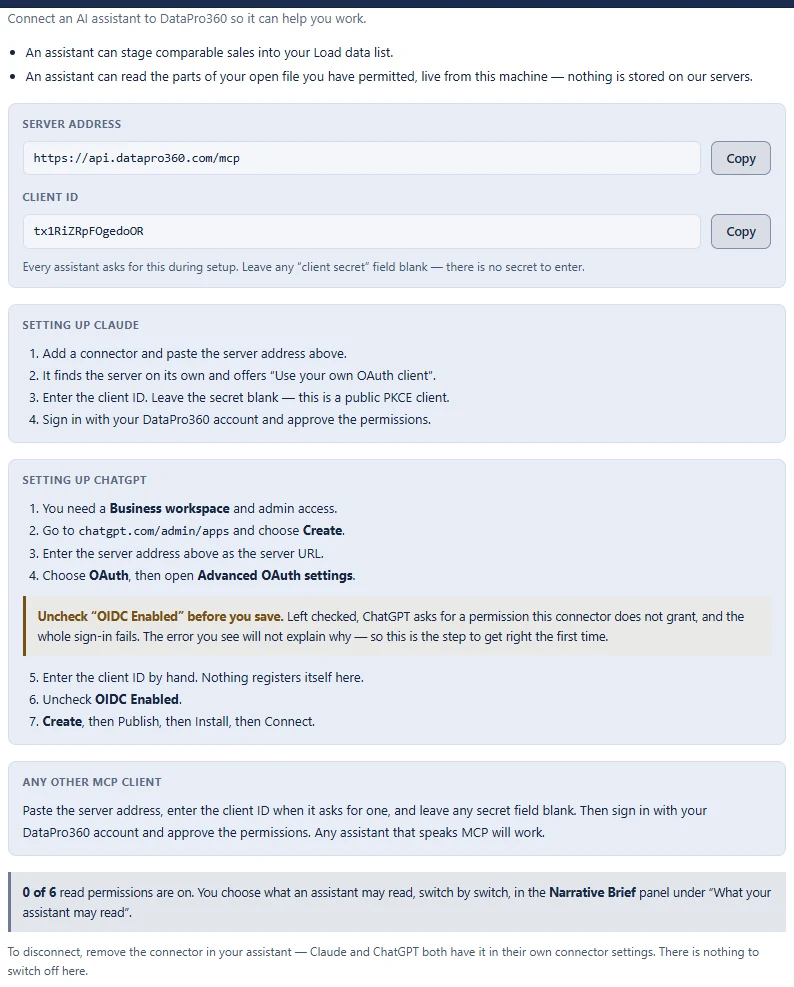
Claude and ChatGPT today, and any assistant that speaks the Model Context Protocol — the connector is built on that open standard, not on a private arrangement with one company. Setup is two values from Settings → Connections: the server address and a client ID. Every assistant asks for the client ID during setup; there is no client secret to enter, because this is a public client — leave any secret field blank.
What this means for data
Nothing is shared until you switch it on, and what you switch on is answered live: a read is answered by the browser you have DataPro360 open in, from the file in front of you — nothing is stored on our servers on the way through, and when the program is closed the read simply fails rather than serving an old copy. DataPro360 has no AI of its own; the one you connect is your provider, under your account with them and under their terms. Nothing you load is used to train anything. The same posture runs through the rest of the program — the privacy policy states it in full.
Doing this in DataPro360
Connect once in your assistant with the two values from Settings → Connections, then grant reads switch by switch in the Narrative Brief panel — starting from Nothing, as every file does. The assistant reads and drafts; the appraiser decides.