Why does the order of adjustments matter?
Douglas Kuss, Certified Residential Appraiser
Because each adjustment layer makes the sales alike in one more way, and the order is the order in which the differences have to come out. A rate measured against the raw sale price carries every difference the other adjustments were also measuring — so the same acreage, or the same market movement, gets charged twice, and nothing in the grid says so.
What "layered" means
Layered means each adjustment is derived on the price the previous layer produced, not on the raw price. Concessions come out first, and the time rate is measured on the concession-adjusted price. Time comes out, and the site rate is measured on the concession-and-time-adjusted price. Site comes out, and living area is measured on the layers above it. By the time the amenities are measured, the price they are measured on no longer carries concessions, market movement, lot size or living area — so what remains between the sales is the features.
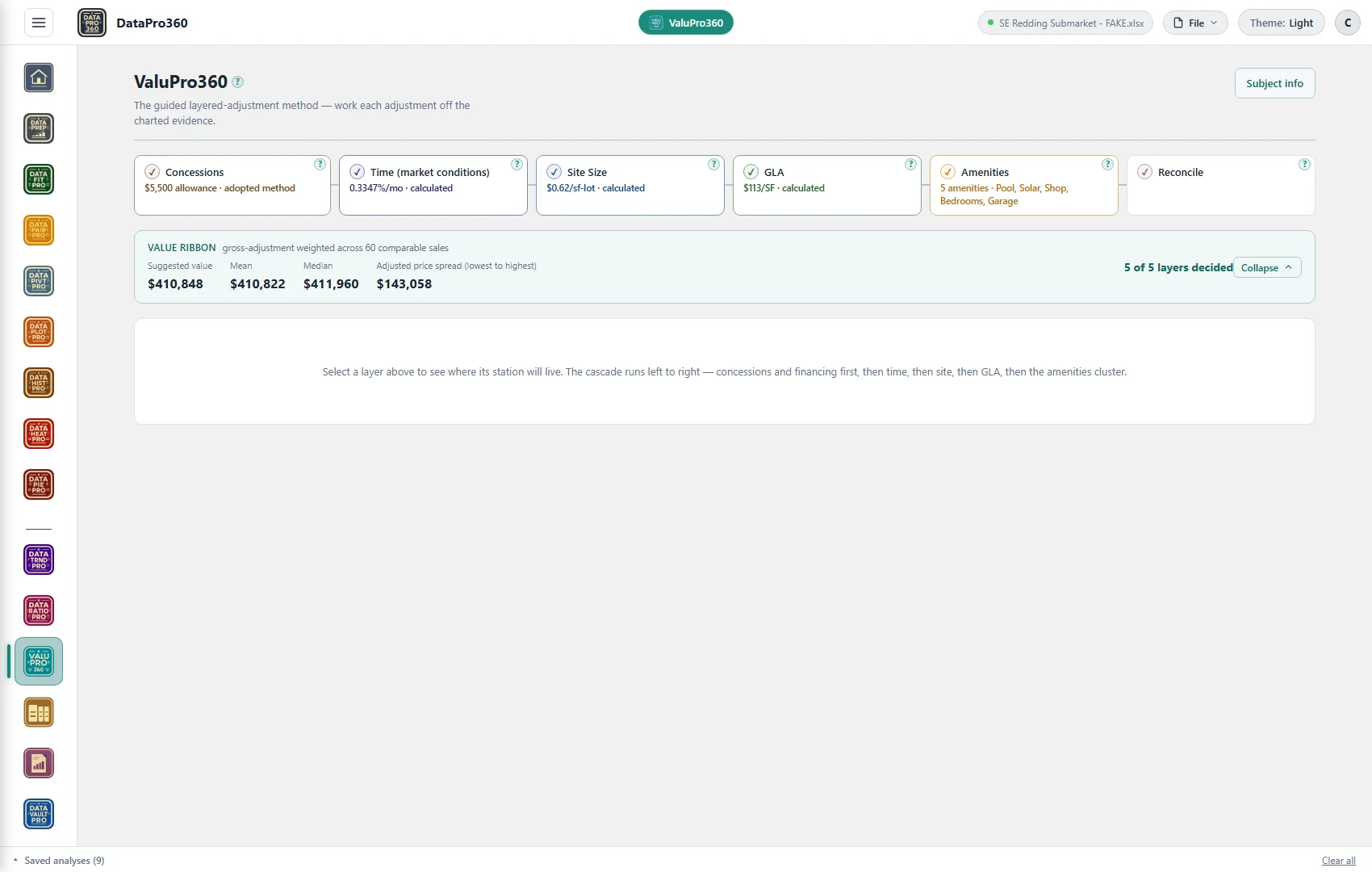
Here is the walk with all five layers decided on a sixty-sale file: concessions at a $5,500 adopted allowance, time at 0.3347% per month, site size at $0.62 per square foot of lot, living area at $113 per square foot, and five amenities each valued at its own level — with the value ribbon reading a suggested $410,848, gross-adjustment weighted across the sixty sales.
Concessions first, and why
A sale that carried $15,000 in seller-paid costs did not transact at its recorded price. Until that money is removed you are not looking at what the market paid, so nothing else can be trusted first. Every later measurement — the time rate, the site rate, the living-area rate, the amenity values — is derived from comparable prices, and if those prices still carry concessions, part of what you measure downstream is seller-paid costs wearing a disguise. The concessions adjustment is first because it is the only layer about the transaction rather than the property.
Time on the concession-adjusted price
Second, the market-conditions adjustment brings every sale to the effective date, so the remaining layers compare sales as of one market rather than across a moving one. It has to come before any property comparison: comparing a sale from two years ago to a recent one on lot size means comparing lot size plus twenty months of market movement, and the lot-size rate will quietly absorb the movement.
Site, then living area, then amenities
Then site size, so the sales are priced as though they sit on the same lot; then living area, so they are priced as though they are the same size house — separated in that order because bigger houses ride on bigger lots, and a rate that measures both at once charges for the acreage twice. Last, the amenity cluster, because by now the sales are otherwise similar and what remains between them is the features — which is exactly what you want to be measuring when you measure features.
The Reconcile station states the whole cascade as a decision stack — each layer's rate, how it was decided, and the price basis it was measured on: the time rate stated as $45.47 per day, the site rate on the concession-and-time-adjusted price, the living-area rate on the basis with site out as well, each amenity priced at its own level. Reconcile decides nothing; every figure on it reads from a decision made at its own station.
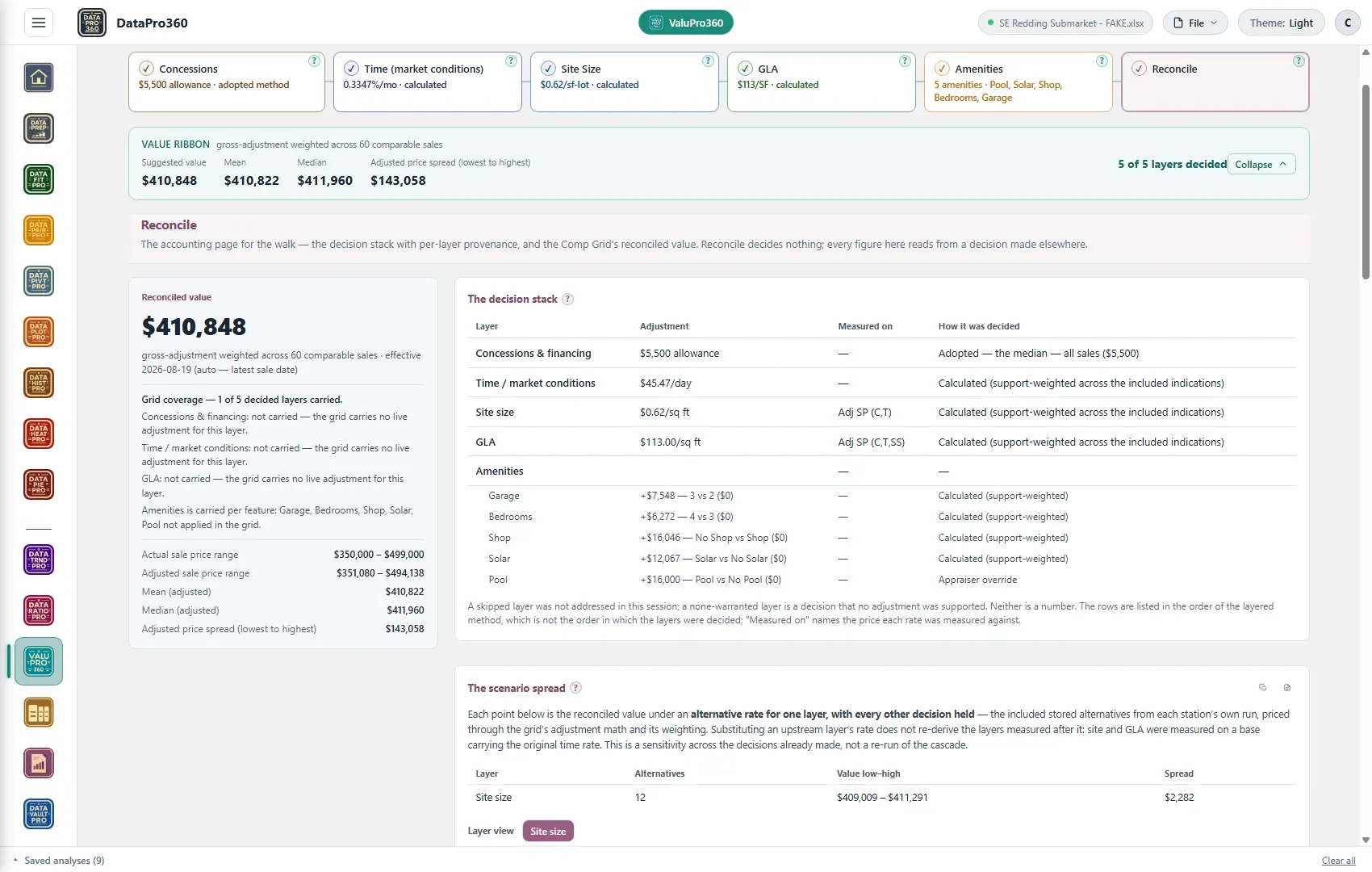
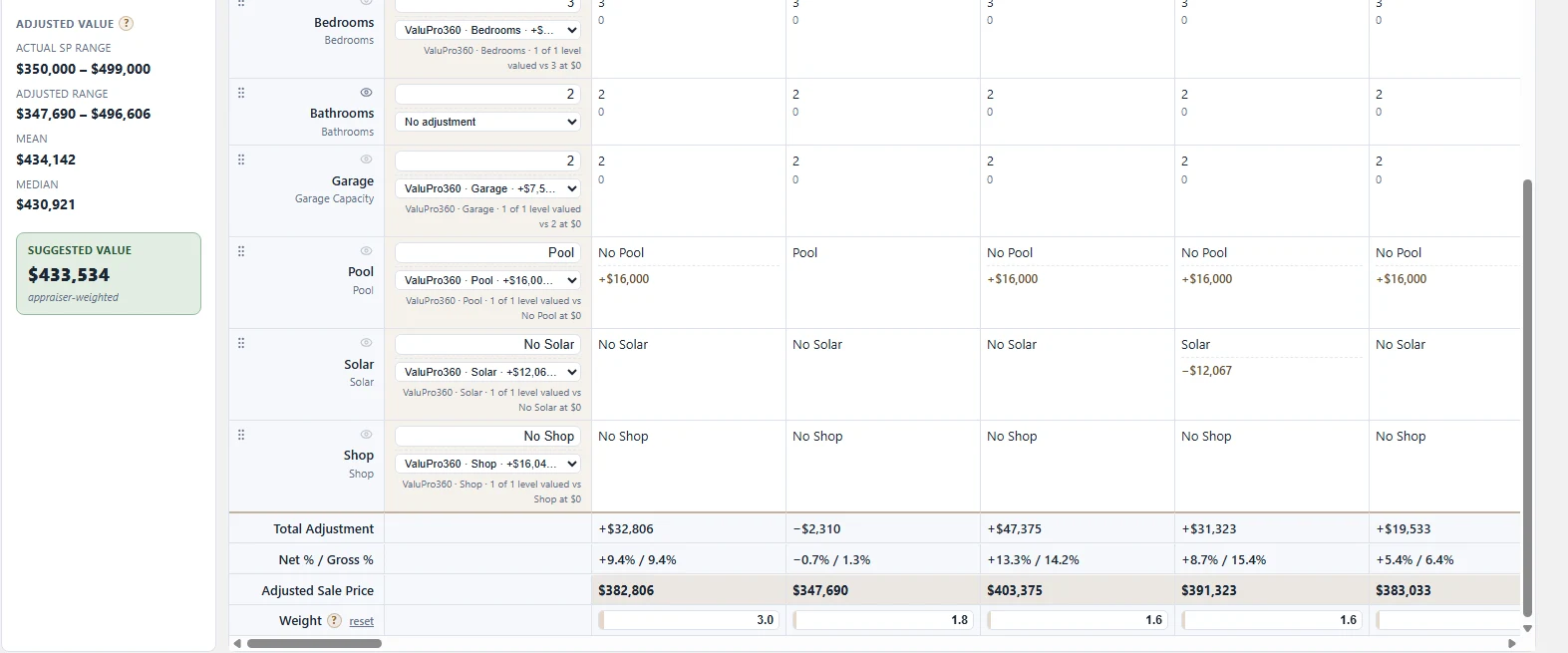
And the decisions travel to the grid by name. Each row carries its source — the station that measured it and the rate it decided — and applies it against the subject, with the per-comparable totals and adjusted prices computed from those named decisions rather than from anything typed into a cell.
What goes wrong when you skip the order
Double counting, and it is invisible. A GLA rate derived on raw prices in a moving market is partly time: the bigger homes sold later, and the slope through their prices carries the market's rise as if square footage caused it. A shop premium measured against raw price is mostly acreage, because homes with shops sit on bigger lots — adjust for the shop and for the lot and you charged for the same land twice. The numbers look reasonable, the reviewer sees nothing wrong on the face of the grid, and the adjusted prices are wrong by the amount of the overlap.
This is also why order matters more than precision. A slightly wrong rate measured against the right base beats a precisely wrong rate measured against the raw price — the layered order removes each difference once and hands the next layer a cleaner base, and no amount of care within a single method substitutes for that.
What belongs in the report
The order itself, stated: which adjustment was derived first, and which price basis each later rate was measured on. A reviewer who can see that the living-area rate was derived on a concession-, time- and site-adjusted price knows it is not carrying acreage or market movement without taking your word for it. Name the basis next to every rate — "measured on the concession-and-time-adjusted price" is one clause, and it answers the question before it is asked.
Doing this in DataPro360
ValuPro360 is this sequence built as a guided walk: six stations in the fixed order, each deriving its adjustment from charted evidence on the price the previous layer produced, and a Reconcile station that gathers the decisions without making any. The order is the method — the program keeps it, and the report states it.