Do I have to adjust for seller concessions, and how?
Douglas Kuss, Certified Residential Appraiser
Yes — a seller concession is money that changed hands as part of the transaction, so it comes off the sale price before anything else is measured. A price that includes one overstates what the market paid for the property, and every adjustment derived downstream — time, site, living area, amenities — inherits that overstatement unless the concession comes out first.
Why the adjustment exists at all
A concession transfers value outside the real estate itself. When the seller pays $12,000 of the buyer's costs, the recorded price includes $12,000 that was not paid for the property, and using that price as market evidence misstates the market.
This is also why the concession adjustment is first in the sequence. Every later measurement — the time rate, the site rate, the living-area rate, the amenity values — is derived from comparable prices. If those prices still carry concessions, part of what you measure as market movement or as a feature's worth is actually seller-paid costs. The adjustment order exists to stop that, and it starts here.
The allowance, and why it is a policy rather than a formula
The clean approach is a single allowance applied across the comparable sales: the amount of concession you treat as ordinary market practice. Only the amount by which a sale's concession exceeds the allowance is removed. An allowance of $0 removes every concession dollar for dollar; a higher allowance removes only the excess, on the reasoning that routine concessions are already priced into what buyers pay. No sale is ever adjusted upward.
The distribution of concessions in your own sales tells you where to set it. Useful bearings: the mean and median across all sales (pulled down by the sales that carried none), the mean and median across only the sales that carried a concession, and a frequency-weighted pair that tempers the typical concession by how often concessions occur at all. These are bearings, not answers — the allowance is a judgment about the market, and dollar-for-dollar is the right call when concessions are not routine practice in the market you are reading. Where verification establishes that one transaction warranted different treatment, override that sale individually and say so.
What the decision looks like
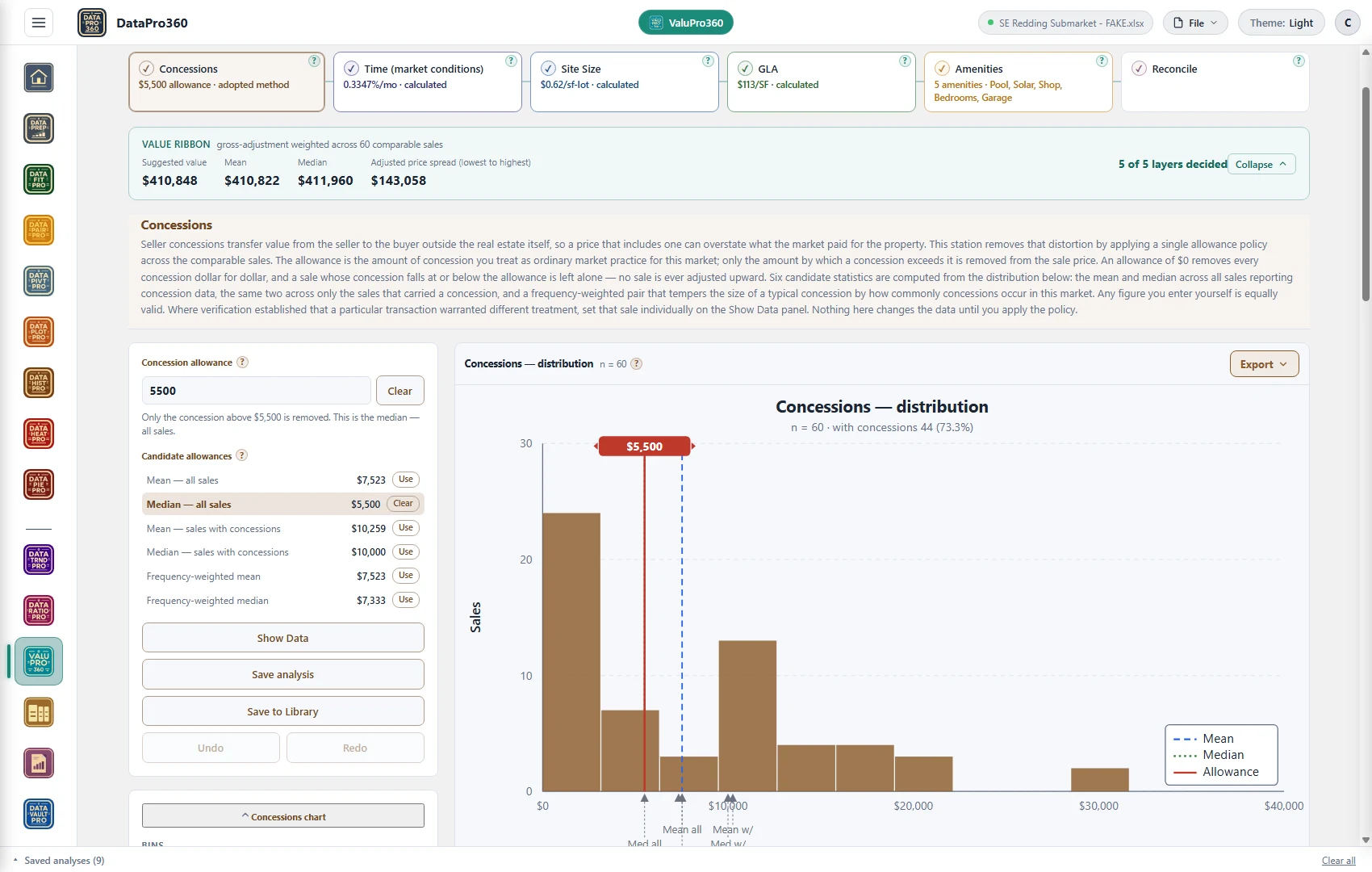
Here is a worked example from a sixty-sale submarket pull. Forty-four of the sixty sales — 73.3% — carried a concession, clustering below $10,000 with a tail past $30,000. Concessions are routine practice in this market, which argues for an allowance rather than dollar-for-dollar.
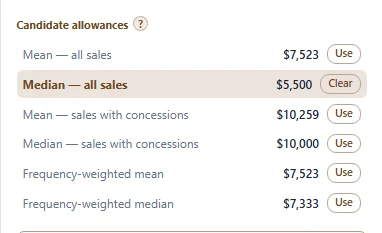
The candidate statistics landed on five distinct amounts: a mean of $7,523 and a median of $5,500 across all sales; a mean of $10,259 and a median of $10,000 across only the sales that carried a concession; and the frequency-weighted pair at $7,523 and $7,333 — the frequency-weighted mean equals the all-sales mean by arithmetic identity, not coincidence.
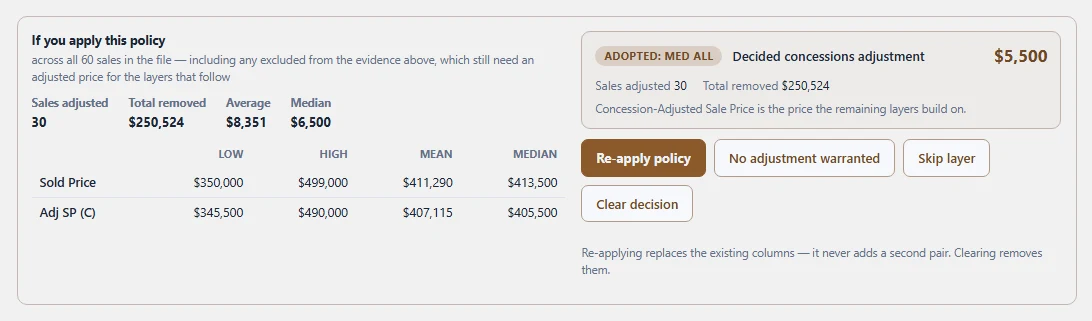
The adopted allowance was the all-sales median, $5,500. Applied across the file, 30 of the 60 sales adjusted — the sales whose concessions exceeded the allowance — by a total of $250,524: an average of $8,351 and a median of $6,500 among the adjusted sales. The median sale price moved from $413,500 to $405,500 on the concession-adjusted basis — and that adjusted price is what every later layer measures against.
Where this adjustment sits in the sequence
First. Concessions come off before anything else is measured, because they are not part of the property's price — they are money moved alongside it. The time adjustment is then derived on the concession-adjusted price, the site and living-area rates follow on the layers above it, and the amenity values are measured last. Everything downstream stands on the number this adjustment produces.
What belongs in the report
The allowance you adopted and why — including why dollar-for-dollar, if that was the call; how many sales carried concessions and how many adjusted; the total removed; and any sale you treated individually on verification, with the reason. A reviewer who can see the distribution, the policy, and the effect of applying it has nothing left to ask.
Doing this in DataPro360
DataPro360's Concessions station charts the distribution, computes the candidate allowances, applies the policy you choose, and records per-sale overrides with the original struck beside them. The concession-adjusted price it produces is the basis every later station builds on.